
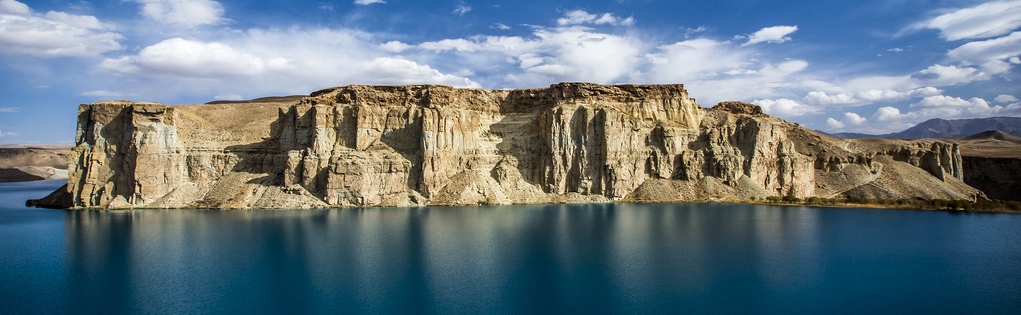
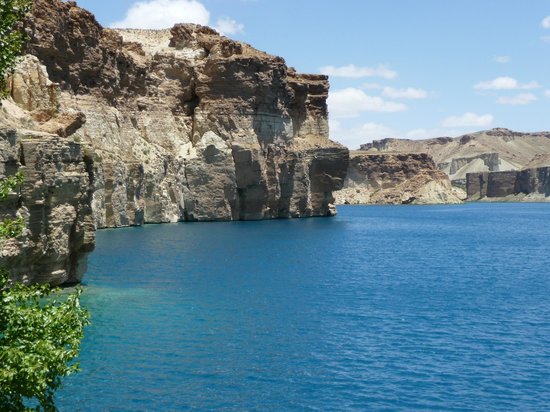
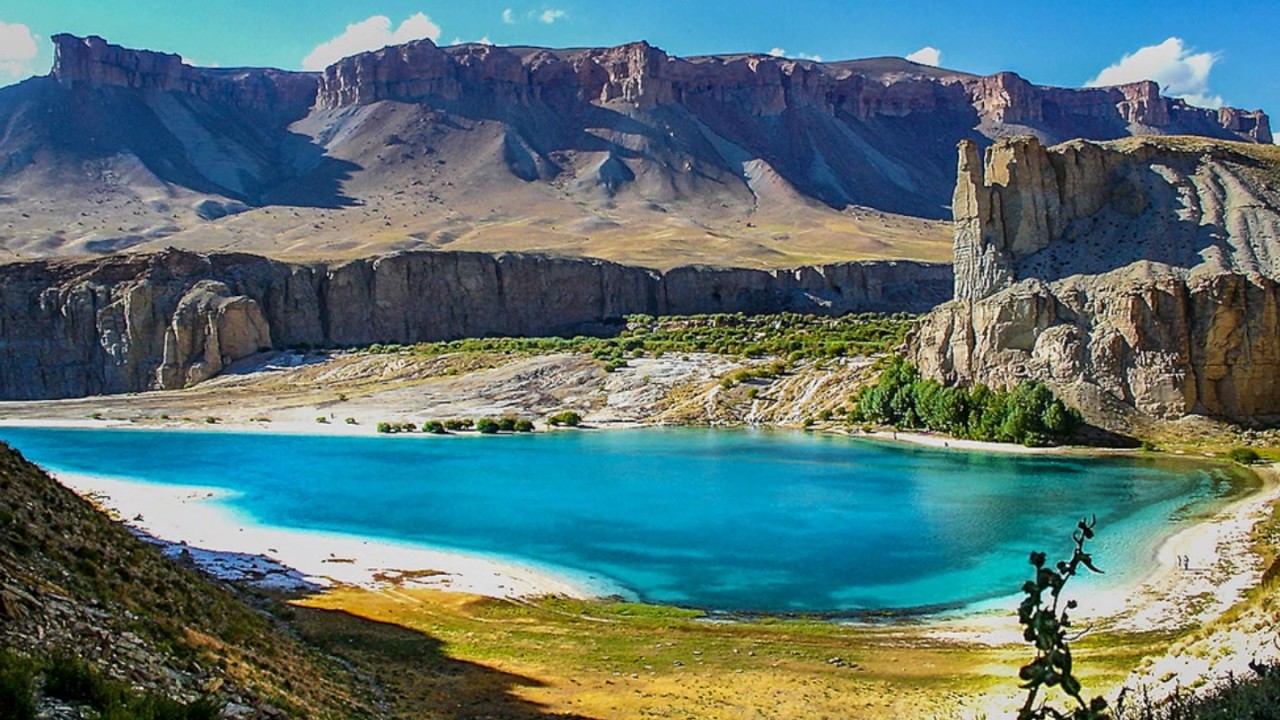
Band-e Amir National Park is Afghanistan’s first national park, located in the Bamyan Province. It is a series of six deep blue lakes separated by natural dams made of travertine, a mineral deposit. The lakes are situated in the Hindu Kush mountains of central Afghanistan at approximately 3000 m of elevation, west of the famous Buddhas of Bamiyan.
They were created by the carbon dioxide rich water oozing out of the faults and fractures to deposit calcium carbonate precipitate in the form of travertine walls that today store the water of these lakes. Band-e Amir is one of the few rare natural lakes in the world which are created by travertine systems. The site of Band-e Amir has been described as Afghanistan’s Grand Canyon, and draws thousands of tourists a year. The river is part of the system of the Balkh River.
Band-e Amir is situated at approximately 75 km to the north-west of the ancient city of Bamyan, close to the town of Yakawlang. Together with Bamyan Valley, they are the heart of Afghanistan’s tourism, attracting thousands of tourists every year and from every corner of the world The six constituent lakes of Band-e Amir are:
Band-e Gholaman (Lake of the slaves)
Band-e Qambar (Lake of Caliph Ali’s slave)
Band-e Haibat (Lake of grandiose)
Band-e Panir (Lake of cheese)
Band-e Pudina (Lake of wild mint)
Band-e Zulfiqar (Lake of the sword of Ali)
Band-e Haibat is the biggest and the deepest of the six, with an average depth of approximately 150 metres, as estimated by the Provincial Reconstruction Team diving team from New Zealand.
The white travertine dams created by fault lines, which are prevalent in the Band-e Amir Valley, form the barriers between the lakes.
Another comparable lake is Band-e Azhdahar (The Dragon), located a few kilometres southeast of the town of Bamyan, which has also been created as a result of carbon dioxide rich water oozing out of the faults underground and depositing calcium carbonate precipitate to form the travertine walls of Band-e Amir.
The Band-e Amir lakes are primarily a late spring and summertime tourism destination, as the high elevation central Hazarajat region of Afghanistan is extremely cold in winter, with temperatures reaching as low as -20C.
The local people in Band-e-Amir National Park rely heavily on the park’s natural resources for their livelihood. Grazing of livestock, collection of shrubs for fuel and winter fodder and rain-fed farming is still widely practiced within the park boundary. Although the illegal hunting of birds and a few mammals living in the park is formally prohibited by the park office, there is no current data to evaluate the status of wildlife and biodiversity.
After the formal establishment of the park in 2009, a park office with a park warden and a group of rangers was installed to manage the conservation and protection of park natural resources. Wildlife Conservation Society (WCS) is the only non-government organization with an office in the park. WCS supports park staff and works with the local community to promote conservation and sustainable use of natural resources.
Ecotourism is expected to decrease local economic dependency on the park’s natural resources. Tourists visit Band-e-Amir primarily in the summer months when the weather is warm. A poor local economy and limited outside investment have hampered efforts to attract winter tourism.
 Afghanistan